

CIS-DF Pre-Exam Practice Tests | (Updated 205 Questions)
Valid CIS-DF Exam Q&A PDF - One Year Free Update
NEW QUESTION # 45
According to theCommon Service Data Model (CSDM), a server team is requesting a catalog item be created for infrastructure requests.
Which role is involved ininitiating the request and defining requirements?
- A. Application Service Owners
- B. Technology Service Owners
- C. Enterprise Architect
Answer: B
Explanation:
In CSDM,Technology Services(and their Service Offerings) representhow technical capabilities are delivered and consumedby internal teams. When a server team requests a catalog item for infrastructure services (e.g., VM provisioning, storage, OS builds), the role responsible forinitiating the request and defining requirementsis theTechnology Service Owner.
Technology Service Owners understand the operational capabilities, constraints, SLAs, and fulfillment workflows required to deliver infrastructure services. They define catalog requirements such as options, approvals, fulfillment tasks, and guardrails-ensuring the request aligns with standardization, security, and operational readiness.
Application Service Ownersfocus on how applications are delivered and supported, not on defining infrastructure catalog items.Enterprise Architectsprovide standards and guidance but do not initiate or define catalog request requirements.
Thus, the correct role isB - Technology Service Owners.
NEW QUESTION # 46
A Configuration Manager is managing a CI class in the CMDB. The identification rules require an update.
Where can the Configuration Manager view and configure the existing identification rules for the class?
(Choose two options.)
- A. CI Class Manager
- B. CI Identifiers module
- C. IRE Application
- D. API Integrations
Answer: A,B
Explanation:
Identification rules can be reviewed and configured through CI Class Manager and the CI Identifiers module .
CI Class Manager provides the modern class-centric interface for managing a CMDB class. It consolidates class hierarchy information, attributes, identification rules, reconciliation settings, principal-class configuration, and recommended relationships. This allows an administrator to understand an identification rule in the context of the class to which it applies.
The CI Identifiers module provides direct access to identification-rule definitions used by the Identification and Reconciliation Engine. These rules specify the attribute combinations that determine whether incoming data represents an existing CI or requires creation of a new CI.
API Integrations does not define IRE identification criteria. "IRE Application" is not the applicable class- level configuration location presented by the platform for this task.
=========
NEW QUESTION # 47
A Configuration Manager needs to enable a CMDB Data Manager policy to remove records from a CI class while retaining the ability to restore them within a specified period.
Which policy type should the Configuration Manager create?
- A. Archive
- B. Delete
- C. Certification
- D. Retire
Answer: A
Explanation:
Archive is the correct policy type because the requirement is not permanent removal; it is controlled removal with the ability to restore records within a defined retention period. In CMDB Data Manager, archive policies support CMDB data lifecycle governance by moving eligible CI records out of active operational use while preserving them for recovery, audit, or historical review. This is different from Delete, which is used when records should be removed permanently and restoration is not the intended governance outcome. Certification is used to validate specific CI attributes, not remove records. Retire changes or manages lifecycle state but does not satisfy the specific requirement to remove records while preserving restore capability. Therefore, when the objective is to reduce active CMDB volume while retaining recoverability, the correct Data Manager policy type is Archive.
NEW QUESTION # 48
A Service Portfolio Manager wants to know which Application Services their Business Service Offerings depend on.
At what stage of CSDM would this relationship be mapped?
- A. Walk
- B. Fly
- C. Run
- D. Foundation
- E. Crawl
Answer: A
Explanation:
The Walk stage introduces the service-model relationships required to connect business-facing services and offerings to the Application Services that technically enable them. At this stage, the organization has progressed beyond foundational CMDB population and begins establishing service context for operational processes.
Relating Business Service Offerings to Application Services allows service owners to determine which technical services support each consumable business offering. This enables impact assessment, outage communication, change-risk evaluation, and identification of affected consumers. The guide explains that the Walk stage establishes Business Services and their relationships with Application Services and infrastructure so the CMDB can support Incident, Problem, and Change impact analysis.
Crawl primarily establishes foundational CI data and ingestion controls. Run and Fly represent more advanced operationalization and optimization. Foundation is a CSDM domain rather than the appropriate maturity stage for this relationship.
=========
NEW QUESTION # 49
A CMDB Administrator would like to minimize stale CIs in the CMDB.
Which CMDB Health Dashboard scorecard displays this information?
- A. Compliance
- B. Correctness
- C. Completeness
Answer: A
Explanation:
In Data Foundations, "Insight" includes measuring CMDB health in ways that are actionable-so teams can identify where data is degrading and prioritize remediation. Stale CIs (records that are no longer current, not updated, or no longer exist in the environment) are a common source of CMDB risk: they distort reporting, mislead impact analysis, and create noise for operational processes. Reducing staleness supports higher trust in the CMDB and better decision-making.
On the CMDB Health Dashboard, stale CI concerns align most closely with Compliance because staleness is fundamentally about whether CIs continue to meet defined governance expectations over time-such as update frequency, lifecycle status controls, and adherence to rules that indicate whether records are still valid.
Compliance scorecards typically highlight rule-based adherence to standards (for example, policies or health rules indicating that certain CI types must be recently updated or must not exceed staleness thresholds). This makes Compliance the right place to monitor and improve staleness.
By contrast, Completeness focuses on whether required attributes are populated (for example, owner, environment, support group). Correctness focuses on whether values are accurate and relationships make sense. While stale records can indirectly affect correctness, the dashboard tracking of "stale" is primarily treated as a governance adherence issue-whether the CMDB is being maintained according to lifecycle and freshness expectations-therefore it is surfaced through the Compliance scorecard.
NEW QUESTION # 50
ACMDB Data Managerneeds to access the ServiceNow platform tocreate, publish, and manage policiesthat automate and governCI lifecycle operations, ensuring the CMDB remains healthy and efficient.
Where can the Data Manager do this?
- A. CI Class Manager
- B. CMDB Workspace - Management tab
- C. CMDB Workspace - CMDB 360 tab
- D. Service Operations Workspace
Answer: B
Explanation:
TheCMDB Data Managerperforms governance activities such ascreating, publishing, and managing lifecycle policies(archival, certification, attestation, cleanup) to ensure long-term CMDB health. These activities are executed within theCMDB Workspace, specifically under theManagement tab.
InServiceNow, theCMDB Workspace - Management tabis the centralized location for CMDB governance operations. From here, Data Managers can define policy logic, assign ownership, schedule execution, monitor outcomes, and manage remediation tasks generated by those policies.
Option A (CMDB 360 tab) focuses onvisibility and analysisof CI data and relationships, not policy authoring.
Option B (Service Operations Workspace) is used for operational response and service monitoring, not CMDB governance. Option C (CI Class Manager) is used to define class hierarchy and ownership, but it does not manage lifecycle policies.
Therefore, the correct location for CMDB Data Manager policy management isCMDB Workspace - Management tab, makingOption Dcorrect.
NEW QUESTION # 51
A ServiceNow Administrator wants to implement Sen/ice Graph Connectors to provide integrations to many third-party solutions that the company wants integrated into the CMDB Which categories of connectors are available to the Administrator"?
- A. Observability
- B. Workflow Automation
- C. Cloud
- D. DevOps
Answer: A,C
Explanation:
Service Graph Connectorsare a keyData Foundations ingestion capabilityinServiceNow. They provideout-of- the-box, upgrade-safe integrationsthat ingest data into the CMDB using theIdentification and Reconciliation Engine (IRE), ensuring data quality and source governance.
Two primary categories of Service Graph Connectors are:
Cloud(Option A): These connectors integrate with major cloud providers and platforms (such as AWS, Azure, and GCP) to ingest infrastructure, platform, and service data into the CMDB. They are essential for managing hybrid and multi-cloud environments and maintaining accurate cloud CI relationships.
Observability(Option B): These connectors integrate with monitoring and observability tools (such as APM, infrastructure monitoring, and telemetry platforms). They provide near-real-time operational data that enriches CI records and supports incident correlation, impact analysis, and service health insights.
Option C (DevOps) is incorrect because DevOps integrations are typically handled through CI/CD tools and workflow integrations rather than Service Graph Connectors. Option D (Workflow Automation) is unrelated; Service Graph Connectors focus ondata ingestion, not process orchestration.
Therefore, the correct connector categories areCloudandObservability, makingOptions A and Bthe correct answers.
NEW QUESTION # 52
(Choose 2 options)
WhichServiceNow solutionscreateautomatic relationships?
- A. IntegrationHub ETL
- B. Discovery
- C. Workflow Studio
- D. Service Mapping
Answer: B,D
Explanation:
Automatic relationship creation is fundamental to maintaining aservice-aware and trustworthy CMDB.
InServiceNow, this capability is primarily delivered byDiscoveryandService Mapping.
Discovery(Option C) automatically identifies infrastructure components-such as servers, network devices, and storage-and createstechnical relationshipsbetween them (for example, "runs on," "connected to," or
"depends on"). These relationships form the backbone of infrastructure dependency mapping.
Service Mapping(Option B) builds on Discovery by creatingapplication- and service-level relationships. It maps how application components interact across servers, databases, and middleware, resulting in accurateApplication Servicemodels aligned with CSDM. These relationships are created and maintained automatically as the environment changes.
Option A (IntegrationHub ETL) focuses on data ingestion and transformation; it does not inherently create or maintain relationships unless explicitly scripted. Option D (Workflow Studio) orchestrates processes and automations but does not discover or infer CI relationships.
Therefore, the ServiceNow solutions that create automatic relationships areService MappingandDiscovery, makingOptions B and Ccorrect.
NEW QUESTION # 53
A CMDB CI Class Owner responsible for the Windows Server class needs to manage the Windows Server class.
Which CI Class Manager feature will help the CI Class Owner streamline this task?
- A. Pinned Classes
- B. Search CI Classes
- C. CI Favorites
Answer: A
Explanation:
The correct answer is Pinned Classes . In CI Class Manager, pinning a class is used to keep frequently managed CI classes easily accessible. A CI Class Owner who regularly manages the Windows Server class does not need to search for it repeatedly through the full class hierarchy. By pinning the class, the owner can return to it quickly, improving administrative efficiency and reducing navigation overhead. "CI Favorites" is not the correct CI Class Manager feature in this context, and "Search CI Classes" can locate a class but does not streamline ongoing repeated management in the same way. Search is useful for one-time discovery, while pinned classes are specifically useful for recurring ownership and class administration tasks. Therefore, the feature that best supports this requirement is Pinned Classes.
=========
NEW QUESTION # 54
Drag and Drop Question
ServiceNow provides a suite of CMDB management tools designed to effectively ingest, manage, and maintain CIs and relationships.
Drag and drop the design architecture to its management tool. (Some options may not apply.)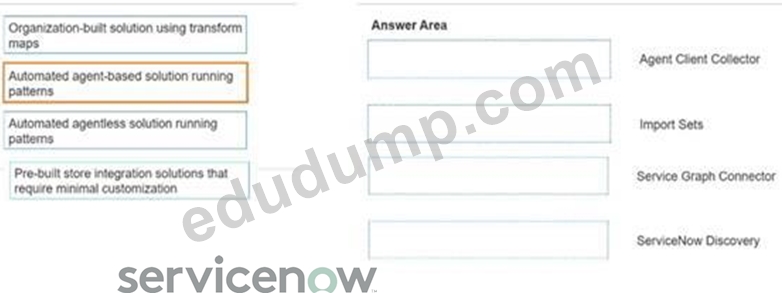
Answer:
Explanation: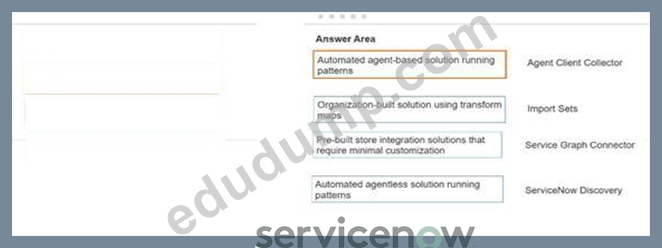
Explanation:
Agent Client Collector: This is ServiceNow's agent-based approach. It requires a software agent to be installed on the target host to run discovery patterns locally.
Import Sets: This is the traditional, manual way to bring in dat a. You define the source, and the organization builds the logic (Transform Maps) to move that data into the CMDB.
Service Graph Connector: These are found in the ServiceNow Store. They are "certified" integrations built to work with specific third-party vendors (like SCCM or Jamf) with minimal setup.
ServiceNow Discovery: The classic agentless method. It probes the network and uses patterns to identify and map CIs without needing software installed on every machine.
NEW QUESTION # 55
A new ServiceNow customer is assembling a Configuration Management team to support their CMDB.
Drag each role to its corresponding job description.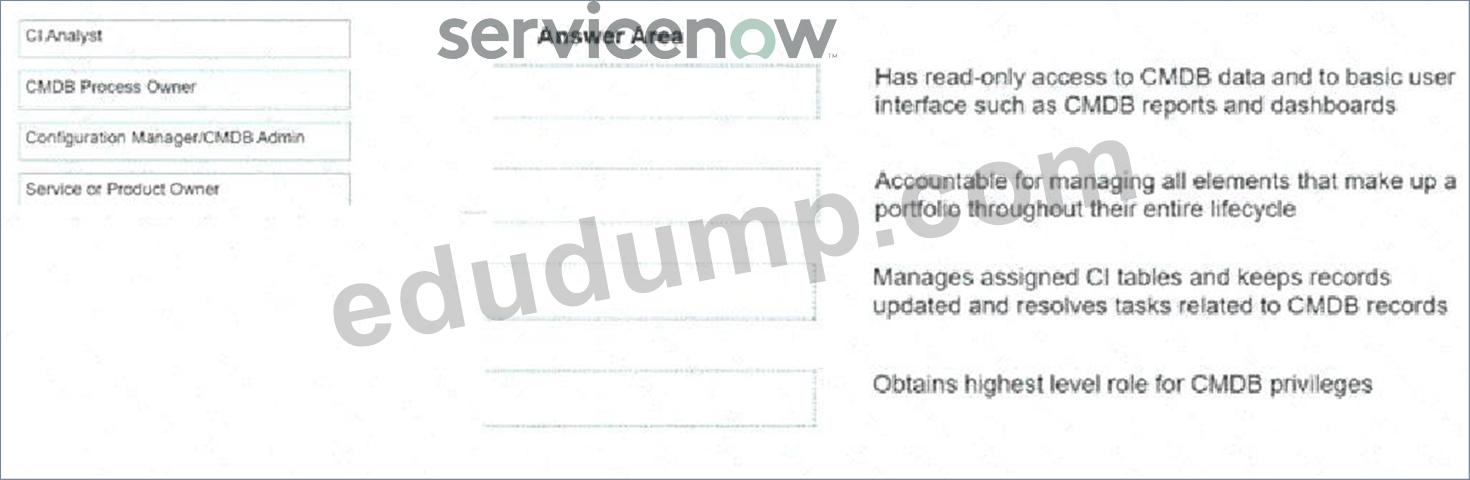
Answer:
Explanation: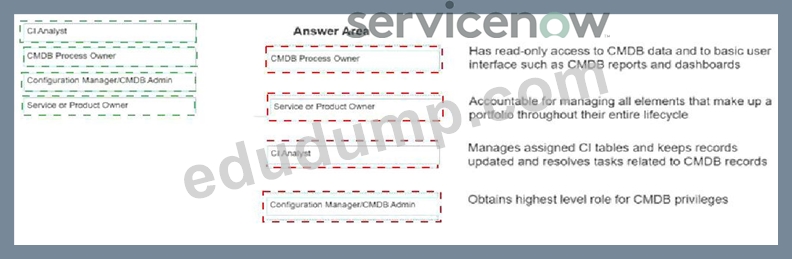
Explanation:
CI Analyst # Manages assigned CI tables, keeps records updated, and resolves tasks related to CMDB records Service or Product Owner # Accountable for managing all elements that make up a portfolio throughout their entire lifecycle Configuration Manager / CMDB Admin # Obtains the highest-level role for CMDB privileges CMDB Process Owner # Has read-only access to CMDB data and to basic user interfaces such as CMDB reports and dashboards
NEW QUESTION # 56
How is the CMDB aligned to business processes?
(Choose 2 options)
- A. Provides a centralized view of configuration items and their relationships
- B. Enables the CFO/CIO to track software licenses
- C. Enhances decision-making and operational efficiency across the organization
- D. Extends service delivery management to all enterprise departments
Answer: A,C
Explanation:
The CMDB aligns to business processes by giving the organization a trusted operational data foundation.
First, it enhances decision-making and operational efficiency because Incident, Problem, Change, Risk, Security, and Service Management teams can assess impact, ownership, dependency, and priority using reliable CI and relationship data. Second, it provides a centralized view of configuration items and relationships , which is the core function of the CMDB. That centralized relationship model is what makes service impact analysis, change risk assessment, outage analysis, and operational routing possible. Tracking software licenses is primarily an IT Asset Management and Software Asset Management concern, not the main CMDB business-process alignment value. Extending service delivery management to all enterprise departments is too broad and belongs more to enterprise service management strategy than core CMDB alignment. Therefore, A and C are correct.
=========
NEW QUESTION # 57
During a bulk import of user endpoint devices into the CMDB, Computer CI records are successfully populated with owner information in the Owned by [owned_by] field. The Asset Management team requires the same owner information to be synchronized automatically to the corresponding Asset records.
Which automated approach should a Configuration Analyst implement?
- A. Implement a custom business rule on the Computer table to script the value into the related Asset record.
- B. Configure a scheduled Transform Map or IntegrationHub ETL workflow to copy the Owned by value from Computer CIs to the Asset table.
- C. Use the Asset-CI Field Mapping module to create a rule that replicates the Owned by value between the Computer CI and its associated Asset record.
- D. Use CI Class Manager to establish a parent-child relationship between the Computer and Asset classes.
Answer: C
Explanation:
The Asset-CI Field Mapping capability is specifically designed to control synchronization between related Asset and CI records. The Configuration Analyst can create or configure a field-mapping rule so that the Computer CI's Owned by value is propagated to the corresponding Asset field through the platform's supported synchronization framework.
CI Class Manager controls CMDB class definitions and does not create parent-child inheritance between Asset and CI tables for field synchronization. A scheduled integration could copy the information, but it introduces unnecessary processing and delay when an out-of-box synchronization mechanism exists. A scripted business rule could also work technically, but it introduces custom code, maintenance effort, and upgrade risk.
Using Asset-CI Field Mapping provides a governed, supportable, and reusable configuration that keeps the operational CI and financial Asset perspectives aligned.
=========
NEW QUESTION # 58
Drag and drop the CMDB Health Dashboard metric to the description.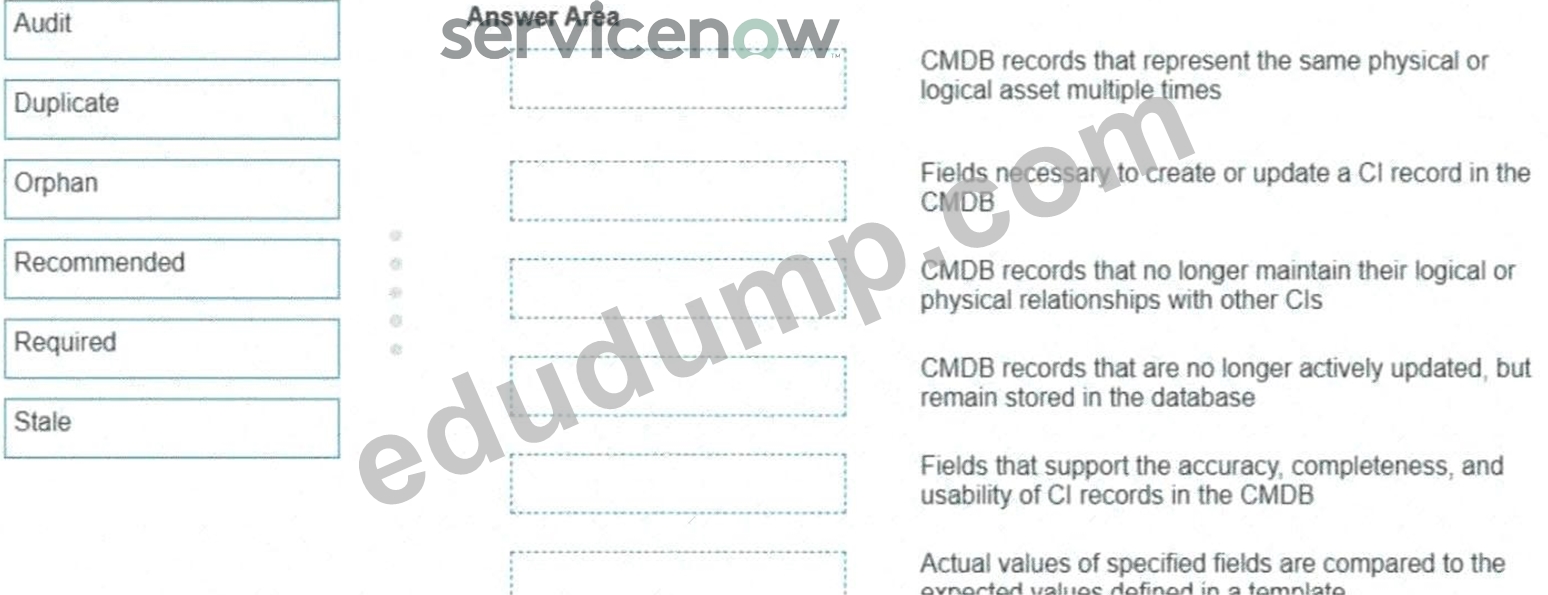
Answer:
Explanation: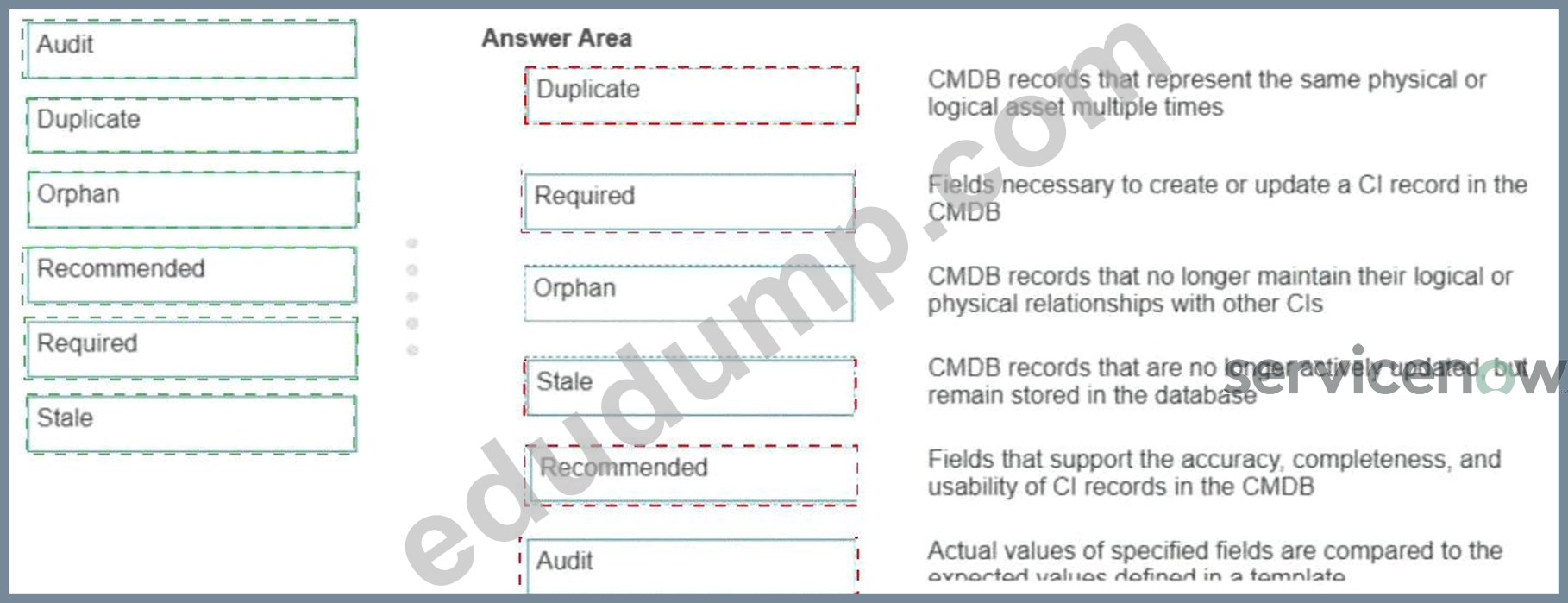
Explanation: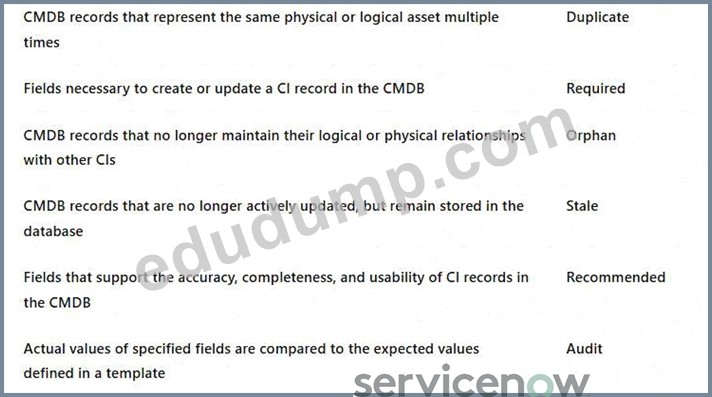
* Duplicate identifies data quality issues where the same asset is modeled more than once, violating CMDB trust principles.
* Required ensures minimum viable CI creation and update-critical for ingestion and lifecycle integrity.
* Orphan highlights broken relationships, which directly impact impact analysis, Service Mapping, and Change Management.
* Stale flags CIs that are no longer being refreshed by Discovery or other sources but still exist in the CMDB.
* Recommended improves completeness and usability, supporting operational and reporting use cases without being mandatory.
* Audit validates data correctness by comparing CI field values against predefined templates or policies.
This exact mapping is what ServiceNow expects in CMDB Health Dashboard-related exam questions and real-world implementations.
NEW QUESTION # 59
A CMDB Administrator is comparing the Unified Map to the Service Mapping map.
What are additional capabilities of the Unified Map? (Choose Two)
- A. Visibility to an application and the host it is installed on
- B. Map can be zoomed in and out
- C. Map nodes can be filtered based on user preferences
- D. Number of levels displayed on a map can be modified
Answer: B,C
Explanation:
The Unified Map is designed to provide enhanced visual insight and analysis across the CMDB by consolidating configuration item (CI) relationships from multiple sources--such as Discovery, Service Mapping, and manual relationships--into a single, interactive view. While traditional Service Mapping maps are optimized for modeling and understanding application-to-infrastructure dependencies, the Unified Map extends this capability with more flexible visualization and exploration features.
Option B is correct because the Unified Map allows users to zoom in and out, enabling both high- level overviews and detailed inspections of complex CI relationships. This capability is particularly valuable in large enterprise environments where services may span hundreds or thousands of infrastructure components. Zoom functionality supports impact analysis, troubleshooting, and architectural reviews without overwhelming the user with unnecessary detail.
Option C is also correct because the Unified Map supports filtering of map nodes based on user preferences. Administrators and analysts can filter by CI class, relationship type, lifecycle state, or other attributes, allowing them to focus on what is most relevant to their task--such as identifying only production CIs, security-relevant components, or a specific technology stack. This aligns strongly with Data Foundations principles by improving usability and decision-making without altering underlying data.
NEW QUESTION # 60
A Business Relationship Manager in an organization wants to implement Service Portfolio Management (SPM) and present offerings to business consumers.
Which CSDM domain does this align with?
- A. Design and Planning
- B. Build and Integration
- C. Service Consumption
- D. Service Delivery
Answer: C
Explanation:
The correct answer is Service Consumption. Service Portfolio Management focuses on defining, organizing, and presenting services and offerings to business consumers. In CSDM, this aligns with the Service Consumption, or Sell/Consume, domain. This domain explains how business-facing services and offerings are made available to users, departments, locations, or customer groups. Design and Planning is concerned with strategic planning objects such as Business Applications, Business Capabilities, and Information Objects.
Build and Integration focuses on development and delivery pipelines. Service Delivery focuses on the technical operation and management of services. Since the scenario is about presenting offerings to business consumers through Service Portfolio Management, it clearly belongs to Service Consumption.
=========
NEW QUESTION # 61
An Enterprise Architect of a financial services company is working across the enterprise and wants to track their capabilities. Which CSDM 5 domain is used? (Choose 1 option)
- A. Design and Planning (Design)
- B. Service Consumption (Sell/Consume)
- C. Build and Integration (Build)
- D. Foundation
- E. Service Delivery (Manage Technical)
Answer: A
Explanation:
In CSDM version 5, enterprise-wide capability tracking is firmly positioned within the Design and Planning domain. This domain is specifically intended to support Enterprise Architecture, Portfolio Management, and Strategic Planning use cases, making it the correct choice for an Enterprise Architect working across the organization.
The Design and Planning (Design) domain focuses on answering "what the business needs and how it should be designed" before services are built or delivered. It includes core concepts such as Business Capabilities, Value Streams, Information Objects, Business Applications, and Architectural relationships. Business capabilities represent what an organization does to achieve its objectives, independent of organizational structure, technology, or implementation. This abstraction is essential for enterprise architects, especially in highly regulated industries like financial services, where strategic alignment and impact analysis are critical.
NEW QUESTION # 62
A CMDB Administrator is implementing Vulnerability Response or Security Incident Response and needs to ensure customers have enough context to estimate risk and set task priorities.
Which Get Well Playbook from the CSDM Data Foundations Dashboard helps with this?
- A. Percentage of Custom Status Values for CI Life Cycle Stages
- B. Application Services with Business Application Relationships
- C. Named Product Models without Product Owners
- D. Locations without a Parent Location
Answer: B
Explanation:
In ServiceNow, Vulnerability Response and Security Incident Response rely heavily on business context to accurately assess risk, prioritize remediation tasks, and communicate impact to stakeholders. From a CSDM (Common Service Data Model) perspective, this context is primarily delivered through properly modeled relationships between Application Services and Business Applications.
The "Application Services with Business Application Relationships" Get Well Playbook directly addresses this requirement. In CSDM, Application Services represent the technical, deployable services that run in the environment, while Business Applications represent the logical applications that support business capabilities. When these two are correctly related, security teams can clearly understand which business processes, customers, and revenue streams are affected by a vulnerability or security incident.
Without this relationship, vulnerabilities may still be detected, but they lack meaningful prioritization. For example, a critical vulnerability on an application service supporting a revenue- generating or customer-facing business application should be addressed far more urgently than one tied to a low-impact internal tool. This relationship is what enables risk-based prioritization, rather than purely technical severity-based prioritization.
NEW QUESTION # 63
When integrating data into the CMDB using Import Sets and Transform Maps, which type of script is added to ensure the data is processed through the Identification and Reconciliation Engine (IRE)?
- A. onStart
- B. onComplete
- C. onAfter
- D. onBefore
Answer: C
Explanation:
When using Import Sets and Transform Maps to ingest data into the CMDB, it is critical that records are processed through the Identification and Reconciliation Engine (IRE) to prevent duplicates and enforce source precedence. In ServiceNow, this is achieved by invoking the IRE after the transform logic has completed.
The onAfter transform script is the correct place to call the IRE API. At this stage, the transformed data has already been mapped and prepared, allowing the IRE to correctly identify whether a CI already exists and reconcile updates according to defined rules.
The onBefore and onStart scripts execute too early--before data mapping is complete--making them unsuitable for IRE processing. The onComplete script runs after the entire import job finishes and is not intended for per-record CI identification and reconciliation.
Because Import Sets can bypass IRE if not configured correctly, using an onAfter script is a critical Data Foundations safeguard when this ingestion method is chosen.
NEW QUESTION # 64
How is an Application Service created with relationships to its underlying infrastructure?
- A. ServiceNow Discovery
- B. Service Mapping
- C. Agent Client Collector
- D. Event Management
Answer: B
Explanation:
Service Mapping creates and maintains an Application Service by discovering the application's entry point and tracing its dependencies across the supporting infrastructure. The resulting service map can include application components, servers, databases, middleware, load balancers, and communication relationships.
This produces the service-aware topology required for impact analysis, incident investigation, and change-risk assessment.
ServiceNow Discovery identifies infrastructure CIs and can create technical relationships between discovered components, but Discovery alone does not normally build the complete, application-centric service topology requested in the question. Agent Client Collector gathers inventory and telemetry from devices through an installed agent, while Event Management processes and correlates operational events and alerts.
The study material identifies Service Mapping as the capability that builds Application Service topology and shows how services are supported by underlying applications and infrastructure. It also describes top-down Service Mapping as the recommended high-fidelity approach for mission-critical Application Services.
=========
NEW QUESTION # 65
Drag and drop the CMDB Health Dashboard metric to the description.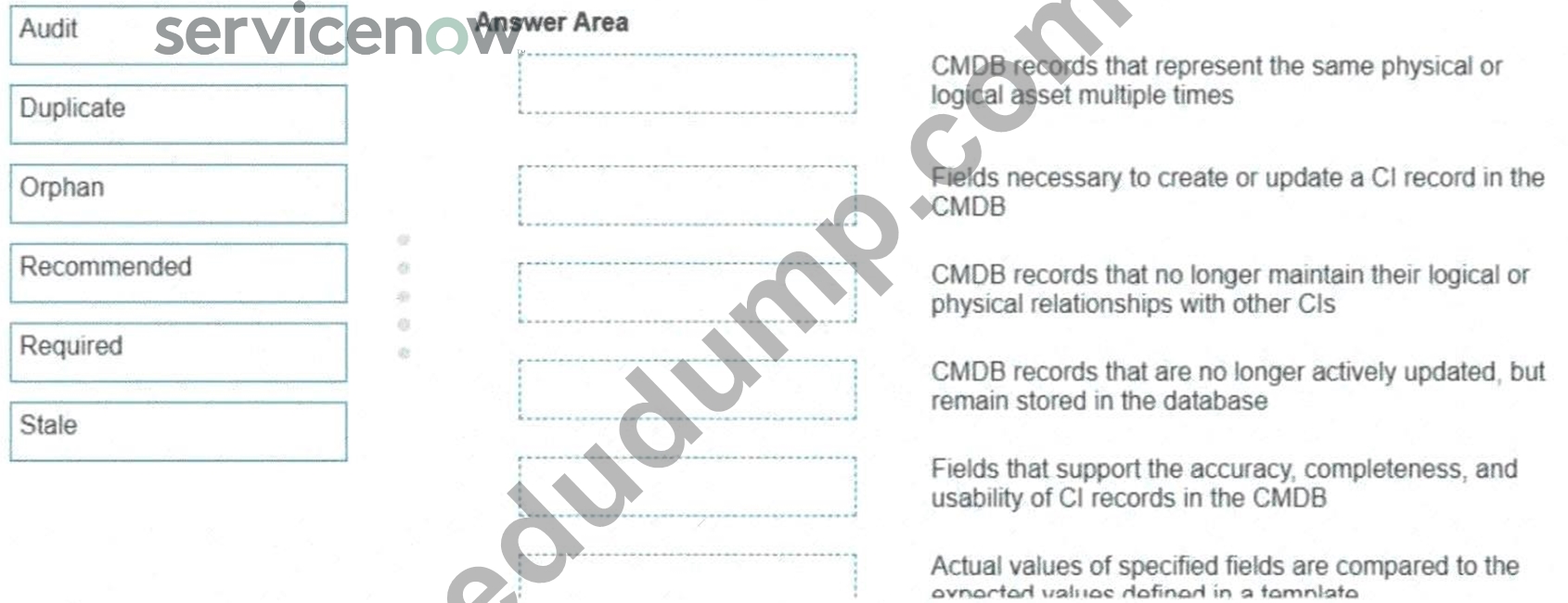
Answer:
Explanation: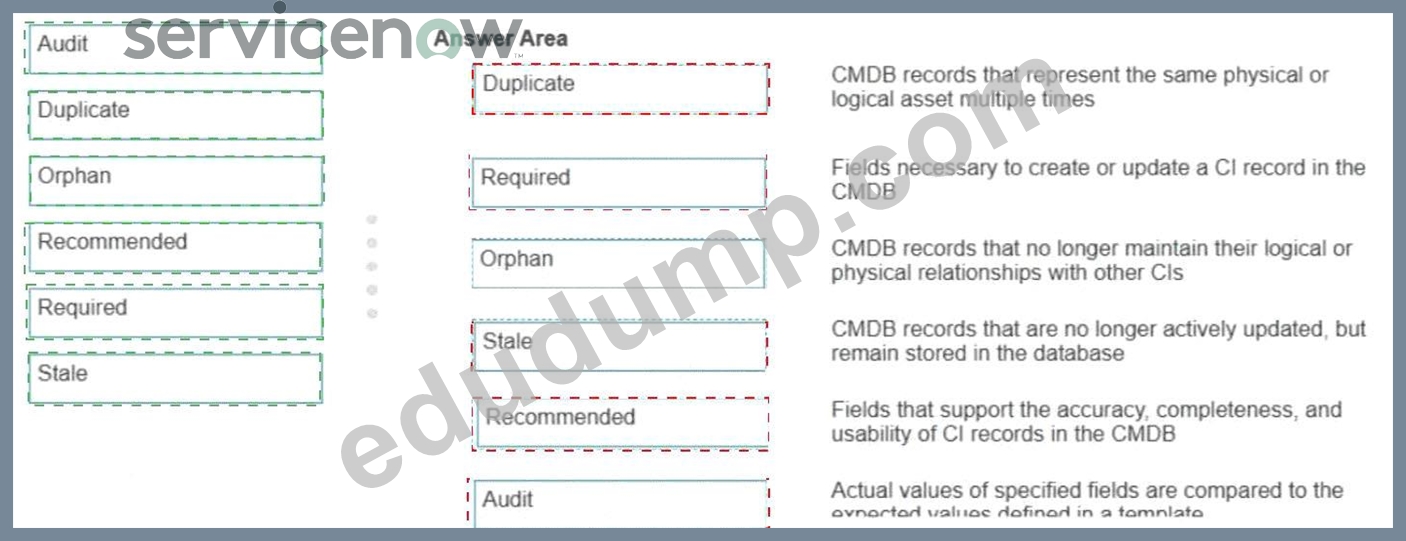
Explanation: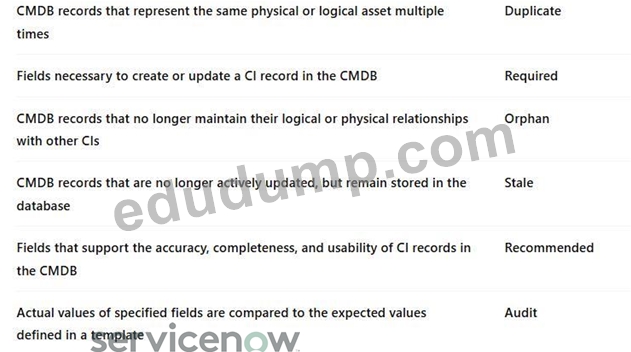
* Duplicate identifies data quality issues where the same asset is modeled more than once, violating CMDB trust principles.
* Required ensures minimum viable CI creation and update-critical for ingestion and lifecycle integrity.
* Orphan highlights broken relationships, which directly impact impact analysis, Service Mapping, and Change Management.
* Stale flags CIs that are no longer being refreshed by Discovery or other sources but still exist in the CMDB.
* Recommended improves completeness and usability, supporting operational and reporting use cases without being mandatory.
* Audit validates data correctness by comparing CI field values against predefined templates or policies.
This exact mapping is what ServiceNow expects in CMDB Health Dashboard-related exam questions and real-world implementations.
NEW QUESTION # 66
A CMDB Administrator wants only the CIs of Principal Classes to appear in CI reference fields, for example the CI reference fields accessible from an Incident form.
Where does the CMDB Administrator designate Principal Classes?
- A. CI Class Manager
- B. CMDB Data Manager
- C. System Properties
- D. CMDB Workspace
Answer: A
Explanation:
Within Data Foundations, "Configuration" includes designing the CMDB data model in a way that supports operational usability-especially for ITSM processes like Incident and Change. One common usability challenge is that CI reference fields (such as the Incident "Configuration item" field) can become cluttered and confusing if they allow selection from every CI class, including highly technical or rarely used classes. To address this, ServiceNow uses the concept of Principal Classes: a curated subset of CI classes that are considered primary for operational selection and reporting.
Principal Classes are designated in the CI Class Manager, because this is where administrators configure and manage CI class behaviors and class-level settings. Defining Principal Classes at the class-management layer ensures that the platform can consistently apply this constraint across CI reference fields and related experiences. This aligns with Data Foundations goals: improving data quality and process outcomes by making it easier for users to select the correct CI, which in turn increases accuracy for assignment, routing, impact analysis, and analytics.
The other options do not fit the responsibility. CMDB Workspace is primarily used for exploring and analyzing CMDB data, not configuring class-level constraints. CMDB Data Manager focuses on governance automation (like lifecycle policies and bulk remediation operations), not CI class designation rules. System Properties may influence global behaviors, but Principal Class designation is a modeling configuration handled through CI class configuration, which is why CI Class Manager is the correct location.
NEW QUESTION # 67
......
ServiceNow CIS-DF Exam Syllabus Topics:
| Topic | Details |
|---|---|
| Topic 1 |
|
| Topic 2 |
|
| Topic 3 |
|
| Topic 4 |
|
| Topic 5 |
|
Certified Implementation Specialist - Data Foundations (CMDB and CSDM) Free Update Certification Sample Questions: https://www.edudump.com/exams/ServiceNow/CIS-DF/
Trend for ServiceNow CIS-DF pdf dumps before actual exam: https://drive.google.com/open?id=11i5YjYT69y2MkD13WbmNfUzWM3fhyzSV